
Every wheat crop starts with a bag of seed. But before that bag reaches your hands, the seed has already been through a long, carefully controlled journey. It starts in a research plot, moves through several growing stages, and gets tested many times before it is sealed and sold.
Knowing this journey helps you buy better seed. It also helps you understand what to expect from a top wheat seeds producer, because the quality of your crop depends a lot on what happens long before sowing.
In this guide, we explain how wheat seed is produced in India, step by step. Whether you are a farmer, a dealer or a bulk buyer, you will learn what each seed class means, what happens in the seed field and the processing plant, and what to check on the bag.
How Is Wheat Seed Produced?
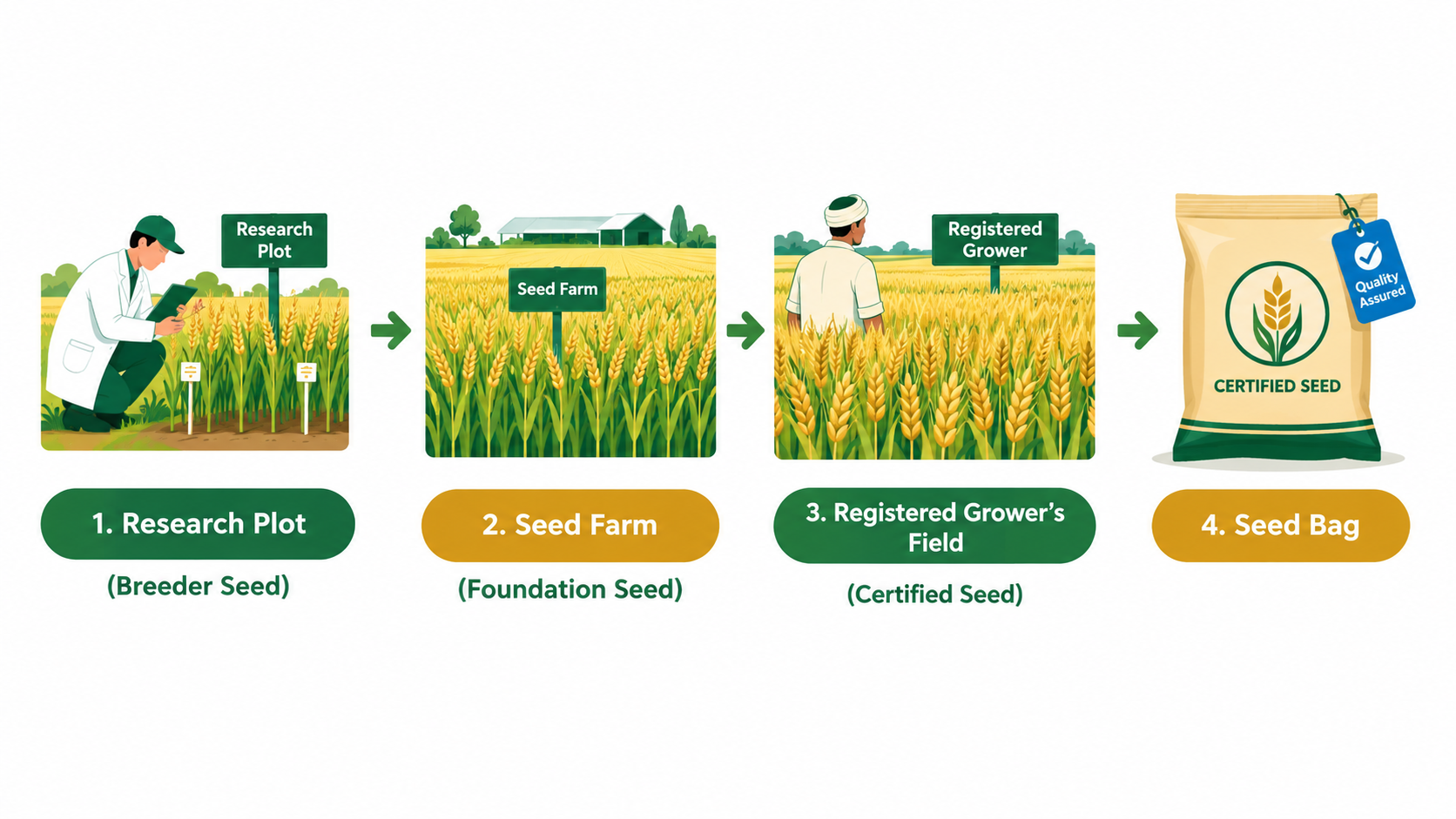
Wheat seed is produced in a chain. Breeder seed from a research institute is multiplied into foundation seed. Foundation seed is then grown into certified seed by registered growers under inspection. After harvest, the seed is dried, cleaned, graded, treated, tested and tagged before it goes to the market.
Why Seed Production Needs So Much Care?
Wheat is a self-pollinating crop, so it stays true to its variety more easily than hybrid crops. Still, a seed lot can easily get spoiled by mixing with other varieties, weed seeds, dust or disease. And a small problem in one seed field can spread across thousands of acres the next season.
That is why India uses a class-based seed system. Each class is grown from the one before it, and each step has rules. Good seed production gives you:
- True-to-type plants that grow and mature evenly
- Strong germination and a uniform crop stand
- Fewer weeds and fewer seed-borne diseases
- A yield that matches what the variety can actually deliver
Step 1: Breeder Seed, Where It All Begins
Breeder seed is the starting point. It is produced by the institute or university that developed the variety, such as ICAR institutes and state agricultural universities. A plant breeder directly supervises it, and its genetic purity is the highest in the whole chain.
The quantity is small, and it is not sold to farmers. Its tag is golden yellow.
Step 2: Foundation Seed, Scaling Up the Original
Foundation seed is grown from breeder seed. It is produced by seed corporations, research stations and approved producers under close supervision. The field is inspected, other varieties and off-type plants are removed, and a fixed gap is kept from nearby wheat fields. For wheat, this isolation distance is about 3 metres.
Foundation seed carries a white tag. It is mostly bought by seed producers who multiply it further.
Step 3: Certified Seed, The Seed Most Farmers Buy
Certified seed is grown from foundation seed. Registered seed growers raise it on their fields, with technical guidance from the seed producer. A state seed certification agency inspects the crop and tests the harvested seed. If the lot passes, it gets an azure blue tag.
This is the seed you normally find in the market. Here is how the three classes compare:
| Seed class | Grown from | Who produces it | Tag colour | Sold to farmers? |
|---|---|---|---|---|
| Breeder seed | Nucleus seed | Research institutes and universities | Golden yellow | No |
| Foundation seed | Breeder seed | Seed corporations, research stations, approved producers | White | Mostly to seed producers |
| Certified seed | Foundation seed | Registered growers under a seed producer | Azure blue | Yes |
What Is Truthfully Labelled Seed?
You may also see truthfully labelled seed. It is not certified by an agency. Instead, the producer is responsible for the quality and states the details on the label. It is still covered by seed law, so the claims on the label must be true. So the producer’s reputation matters even more here.
Step 4: What Happens in the Seed Field
Land, Sowing and Timing
Seed growers pick land where a different wheat variety did not grow earlier, so stray plants do not mix into the crop. They sow tagged source seed at the right time. Sowing on time matters for seed crops as much as for grain crops, and our post on late sowing and wheat yields explains what delays can cost.
Isolation and Roguing
Roguing means walking the field and pulling out any plant that does not belong. These can be off-type wheat plants, other crops, or weeds like wild oat and Phalaris minor (gulli danda). Growers do this at several growth stages, because some off-types only show up near flowering or maturity.
Field Inspections
The certification agency visits the field at key stages. Inspectors check isolation, variety purity, weeds and disease. A field that fails the standard can be rejected, and its harvest cannot be sold as certified seed.
Harvest and Threshing
The crop is harvested at the right maturity. The harvester, thresher and storage area are cleaned before use, so seed from one variety does not mix with another.
Step 5: Processing, From Raw Harvest to Clean Seed
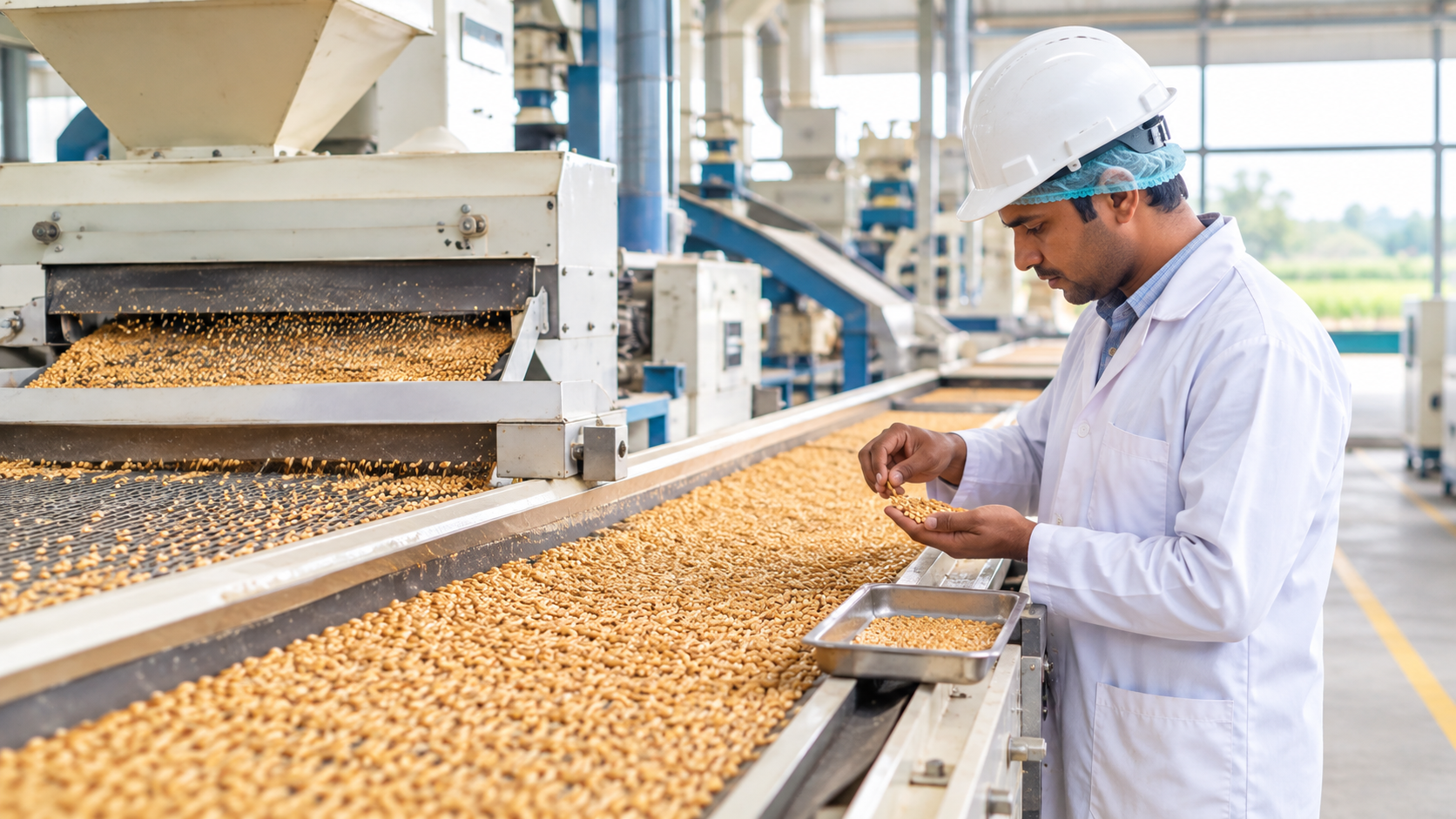
After harvest, seed goes to a processing plant. This is where ordinary-looking grain becomes real seed.
- Drying: Seed is dried to a safe moisture level. For wheat, the limit is about 12 percent.
- Pre-cleaning: Dust, straw and large trash are removed.
- Cleaning and grading: Air-screen machines and sieves remove small, broken and shrivelled grains. Gravity separators take out light or damaged seed.
- Seed treatment: Seed is treated with recommended fungicides and insecticides to protect it from seed-borne diseases and soil pests.
- Packing: Seed is packed in clean, labelled bags in fixed sizes.
Step 6: Seed Testing, The Final Gate
Before any lot is sold, samples go to a seed testing laboratory. The lab checks the things that matter most to the farmer.
| Test | What it checks | Certified wheat standard |
|---|---|---|
| Physical purity | Share of pure seed versus inert matter, weed seed and other crop seed | Minimum 98% |
| Germination | How many seeds sprout under lab conditions | Minimum 85% |
| Moisture | Water content in the seed | Maximum 12% |
| Genetic purity | Whether the seed is true to the variety (checked in the field and by grow-out tests) | As per certification standards |
| Seed health | Presence of seed-borne diseases | As required |
These figures follow the Indian Minimum Seed Certification Standards. Always read the tag on your bag for the exact values of that lot.
Step 7: Tagging, Packing and Dispatch
Once a lot passes, it gets its tag and lot number. A proper wheat seed tag shows:
- Crop and variety name
- Seed class and lot number
- Date of test and validity period
- Purity and germination percentage
- Seed treatment chemicals used
- Net weight and the producer’s name and address
Store seed in a cool, dry place, off the floor and away from damp walls. Wrong storage can undo all the earlier work.
What This Means for Farmers, Dealers and Bulk Buyers
Once you know the chain, you know where to look. A top wheat seeds producer should be able to show proof at each step. Here is what to check, depending on who you are:
| If you are a… | Check this | Why it matters |
|---|---|---|
| Farmer | Tag, seed class, lot number, test date, sealed bag, bill | Confirms you are buying traceable seed |
| Dealer | Source documents, batch records, storage conditions | Helps you handle complaints and returns |
| FPO or bulk buyer | Test reports, sample lot before booking, packing and dispatch timelines | Avoids mix-ups and late supply before sowing |
If you are still deciding which variety suits your area, our region-wise guide to wheat seed varieties in India is a good place to start. If you buy in large quantities, the complete buyer guide to wheat seed manufacturers in India covers what to ask before you place an order.
Common Mistakes That Lower Wheat Seed Quality
- Growing seed on land that had another wheat variety last season
- Skipping or delaying roguing
- Using the same thresher or storage area for different varieties without cleaning
- Harvesting too early or too late
- Storing seed with high moisture
- Buying loose or untagged seed with no lot number