
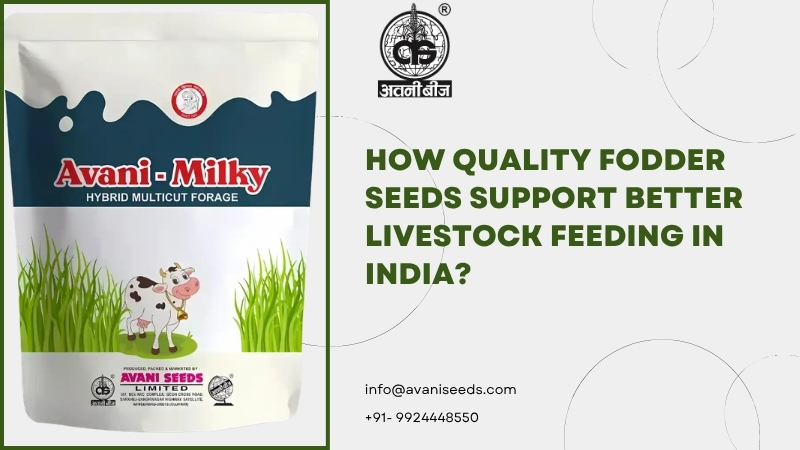
Livestock farmers need a dependable source of forage to maintain a practical feeding system.Fresh fodder can contribute fibre, nutrients, and dietary variety to livestock rations, while reducing dependence on purchased feed in some farming systems.
But producing useful fodder begins well before harvest.Seed selection, crop suitability, soil, water availability, sowing time, and crop management all influence the eventual forage supply.For farmers searching for a Fodder Seeds Supplier in India, understanding these factors can make seed selection more useful than simply choosing a variety based on a general yield claim.
Why Fodder Quality Matters in Livestock Farming?
Fodder is an important component of feeding systems for cattle, buffaloes, goats, sheep, and other livestock.The nutritional value of forage varies according to the crop species, maturity at harvest, growing conditions, and management.Good fodder planning can help farmers maintain a more consistent supply of usable forage.
Fresh forage can provide fibre that supports normal rumen function in ruminant animals.Some fodder crops also contribute protein and other nutrients.However, no single fodder crop should automatically be considered a complete feed.Livestock diets generally need to be balanced according to the animal’s species, age, production stage, health status, and nutritional requirements.
Fresh Fodder and the Role of Crop Diversity
Depending on local conditions, farmers may grow more than one fodder crop.This can provide flexibility across different seasons and help reduce dependence on one crop.For example, farmers may combine grass or cereal-based fodder with suitable leguminous crops as part of a broader feeding strategy.
Crop diversity can also help manage differences in:
- Growing periods
- Water requirements
- Seasonal availability
- Forage characteristics
The exact combination should be selected according to local agricultural conditions and livestock needs.
What Should Farmers Consider When Selecting Fodder Seeds?
There is no single fodder seed that is ideal for every farm in India.The country has significant variation in climate, soil, rainfall, temperature, irrigation access, and livestock systems.A seed variety suitable for one region may not perform in the same way somewhere else.Farmers should therefore consider several factors before selecting seed.
Climate
Temperature and rainfall influence crop establishment and growth.Some crops perform better during cooler periods, while others are better suited to warmer conditions.
Soil
Soil type, fertility, drainage, and pH can influence crop development.Where necessary, farmers can use soil testing and local agricultural recommendations to identify suitable crops.
Water Availability
Irrigated and rainfed farms may have different fodder options.Where water is limited, farmers may need to prioritise crops that fit their available water resources rather than selecting varieties based only on expected biomass.
Livestock Requirements
The type of livestock matters.A dairy operation may have different forage requirements from a goat or sheep farm.The intended use of the harvested fodder should therefore be considered before selecting seed.
Seasonal Fodder Planning
Seasonal planning can help farmers maintain a more predictable forage supply.India’s growing conditions change considerably throughout the year.
Temperature, rainfall, irrigation, and day length can affect fodder crop establishment and development.Rather than depending on one crop throughout the year, farmers can consider a planned combination of suitable seasonal crops.
Why Seed Quality Matters for Fodder Crop Establishment?
Even a well-planned fodder programme can perform poorly if the seed quality is unsuitable.Seed quality influences the potential for successful crop establishment.
Farmers should pay attention to factors such as:
- Germination
- Physical purity
- Variety identity
- Seed handling
- Storage conditions
- Product information
Poorly stored seed may lose viability over time.Seed should therefore be purchased from a source that provides clear information about the product and follows suitable storage and handling practices.
Buying from a Reliable Fodder Seeds Supplier
A dependable supplier should make it easier for farmers to understand what they are purchasing.Product information should ideally make the seed identity and intended agricultural use clear.
Farmers can also ask about relevant quality information, packaging, lot details, and recommended storage conditions.For a Fodder Seeds Supplier India search, the supplier’s location is only one consideration.Product suitability and reliable information are equally important.
Fodder Seeds and More Efficient Livestock Farming
Fodder production can contribute to better use of agricultural land when crops are selected and managed according to local conditions.A planned forage system may help farmers reduce periods when fresh fodder is difficult to obtain.
It can also support more predictable feed planning.
Sustainable fodder production can involve:
- Matching crops to available water
- Planning crops around local seasons
- Rotating suitable crops
- Reducing avoidable crop losses
- Using farmland efficiently
Fodder Planning Under Changing Weather Conditions
Weather variability can make fodder production more challenging.Unexpected rainfall, extended dry periods, high temperatures, or changing seasonal patterns can influence crop establishment and harvest timing.Farmers can reduce some of this uncertainty by avoiding dependence on a single crop where practical.
Maintaining suitable crop diversity and planning sowing schedules according to local forecasts and agricultural advice can improve flexibility.However, no seed variety can eliminate weather-related production risk.Crop choice should always be matched with realistic farm resources.
Modern Fodder Farming Trends and Choosing a Fodder Seeds Supplier in India
Fodder production is becoming an increasingly planned part of livestock farming.Rather than treating forage as an occasional crop, many farmers are looking at seasonal planning, crop diversification, efficient resource use, and reliable seed sourcing as part of their overall feeding strategy.For anyone searching for a Fodder Seeds Supplier India, understanding these trends can help with making a more informed purchasing decision.
Conclusion
Quality fodder production starts with informed crop and seed selection.Farmers need to consider climate, soil, water availability, season, livestock requirements, crop duration, and seed quality before making a decision.A planned approach can make fodder cultivation more organised and help farmers prepare for seasonal changes in forage availability.
For those searching for a Fodder Seeds Supplier India, the focus should be on finding suitable seed options supported by clear product information and responsible sourcing practices.Avani Seeds can be explored by farmers looking for fodder seed options for different livestock-farming requirements.The right seed is not simply the one with the strongest marketing claim it is the one that fits the farm, season, livestock, and available resources.