
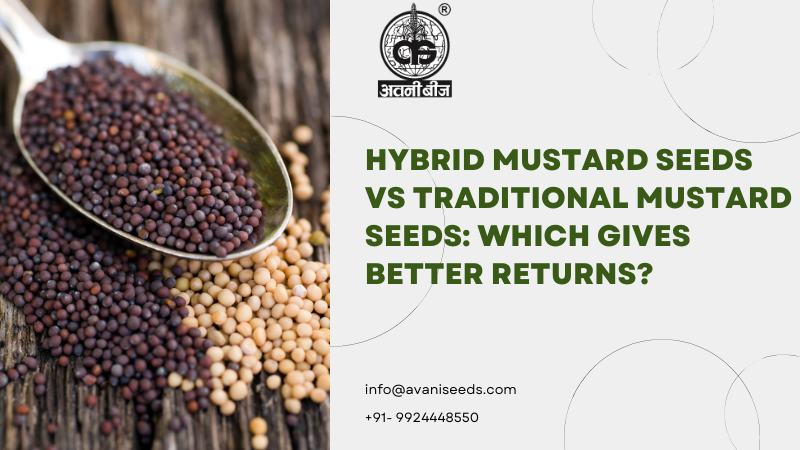
Mustard is one of India’s most important oilseed crops, contributing significantly to agricultural income and edible oil production. As farming practices evolve, many growers face a common question: should they choose hybrid mustard seeds or continue cultivating traditional mustard seeds?
While both seed types have their advantages, the right choice depends on factors such as yield expectations, investment capacity, climatic conditions, and long-term profitability. Understanding the differences between these options can help farmers maximize returns and make informed decisions.
In this guide, we’ll compare hybrid vs traditional mustard seeds and explore which option offers better economic benefits for modern farming.
Understanding Hybrid Mustard Seeds
Hybrid mustard seeds are developed by combining selected parent lines to create improved varieties with enhanced agricultural characteristics.
These seeds are specifically designed to provide better performance under modern farming conditions.
Key Features of Hybrid Mustard Seeds
- Higher yield potential
- Better plant uniformity
- Improved adaptability
- Enhanced resistance to environmental stress
- Stronger growth performance
Many commercial farmers prefer hybrid varieties because they focus on maximizing productivity and profitability.
Farmers looking for premium-quality seed varieties can explore options from a trusted Mustard Seeds Supplier India to ensure better crop performance.
What Are Traditional Mustard Seeds?
Traditional mustard seeds are varieties that have been cultivated for generations and are often adapted to local farming conditions.
These seeds are commonly preserved and reused by farmers from previous harvests.
Advantages of Traditional Mustard Seeds
- Lower initial seed cost
- Familiar cultivation practices
- Suitable for low-input farming
- Ability to save seeds for future seasons
Traditional varieties remain popular among farmers who prioritize seed conservation and lower investment costs.
However, they may not always provide the same production levels as modern hybrid varieties.
Hybrid vs Traditional Mustard Seeds: Major Differences
When comparing hybrid vs traditional mustard seeds, several factors directly influence profitability and farm performance.
- Yield Potential
Yield is often the most important consideration for farmers.
Hybrid Mustard Seeds
- Higher production capacity
- More uniform plant growth
- Better pod development
- Increased seed output
Traditional Mustard Seeds
- Moderate productivity
- Variable plant performance
- Lower yield consistency
Farmers aiming for commercial-scale production often find that hybrid mustard seeds offer greater income potential due to their higher productivity.
- Crop Uniformity
Uniform crops make field management easier and improve harvesting efficiency.
Hybrid Varieties
- Consistent plant height
- Uniform flowering
- Better maturity synchronization
Traditional Varieties
- Greater variation between plants
- Uneven maturity
- Variable seed quality
Uniformity helps farmers achieve more predictable harvest outcomes.
- Resistance to Environmental Stress
Climate conditions continue to become more unpredictable, making crop resilience increasingly important.
Hybrid Mustard Seeds
- Better adaptability to changing weather
- Improved stress tolerance
- Stronger recovery after adverse conditions
Traditional Mustard Seeds
- Depend heavily on local environmental suitability
- May be more sensitive to extreme weather fluctuations
This factor often influences profitability in regions experiencing irregular rainfall or temperature variations.
- Seed Cost and Investment
One area where traditional mustard seeds have an advantage is initial cost.
Traditional Seeds
- Lower purchasing expense
- Can often be reused
Hybrid Seeds
- Higher upfront investment
- Fresh seed purchase recommended each season
Although hybrid seeds require greater investment, many farmers recover the cost through increased production and market returns.
Which Option Offers Better Economic Returns?
The answer depends on how profitability is measured.
Some farmers focus only on seed cost, while others evaluate overall farm income.
Why Hybrid Mustard Seeds Often Generate Better Returns
(1) Higher Yield Per Acre
Greater productivity increases total marketable output.
(2) Better Crop Uniformity
Improves harvesting efficiency and grain quality.
(3) Reduced Production Risk
Improved adaptability can help maintain productivity during challenging seasons.
(4) Stronger Commercial Potential
Higher production often translates into greater overall revenue.
For commercial farming operations, hybrid mustard seeds generally provide a stronger return on investment despite the higher initial cost.
When Traditional Mustard Seeds May Be the Better Choice
Although hybrids offer many advantages, traditional mustard seeds still have value in certain farming situations.
Suitable Scenarios
- Small-scale farming
- Low-investment agriculture
- Seed-saving practices
- Localized cultivation systems
Farmers with limited resources may prefer traditional varieties because of their lower input requirements.
Factors to Consider Before Choosing Mustard Seeds
Every farm operates under different conditions.
Before selecting seed varieties, farmers should evaluate several important factors.
(1) Climate Conditions
Choose varieties suitable for local weather patterns.
(2) Soil Quality
Fertile and well-managed soils often maximize hybrid performance.
(3) Irrigation Availability
Adequate moisture supports higher-yielding varieties.
(4) Farming Objectives
Determine whether the goal is:
- Maximum yield
- Lower investment
- Long-term seed preservation
- Commercial profitability
(5) Market Demand
Understanding local market requirements can help maximize returns.
Working with experienced Agriculture Seed Suppliers in India can help farmers identify suitable varieties based on their specific farming goals.
Tips for Improving Mustard Crop Profitability
Regardless of seed type, good farm management remains essential.
Best Practices
(1) Use Quality Seeds
Certified seeds improve crop establishment and performance.
(2) Follow Proper Nutrient Management
Balanced fertilization supports healthy growth.
(3) Monitor Crop Health
Early detection of pests and diseases reduces losses.
(4) Maintain Proper Plant Population
Correct spacing improves airflow and nutrient utilization.
(5) Harvest at the Right Time
Timely harvesting helps preserve grain quality and yield.
Combining these practices with the right seed selection can significantly improve farm income.
Conclusion
The debate between hybrid mustard seeds and traditional mustard seeds ultimately depends on farming goals, available resources, and profit expectations.
Traditional varieties continue to serve farmers seeking lower input costs and seed-saving opportunities. However, for growers focused on maximizing production, improving crop uniformity, and increasing commercial returns, hybrid mustard seeds often provide a stronger economic advantage.
When evaluating hybrid vs traditional mustard seeds, it is important to consider total profitability rather than seed cost alone. Higher yields, better adaptability, and improved crop performance can make hybrids a valuable investment for modern agriculture.