
Table of Contents
- Quick Identification: Which Disease Is It?
- 1. Cumin Blight (Charmi): The Fastest Crop Killer
- How to Identify Blight
- Why and When It Comes
- How to Control Blight
- 2. Cumin Wilt (Sukaro): The Soil-Borne Problem
- How to Identify Wilt
- Why and When It Comes
- How to Control Wilt
- 3. Powdery Mildew (Bhuki Chharo): The White Powder
- How to Identify Powdery Mildew
- Why and When It Comes
- How to Control Powdery Mildew
- Season Plan: Cumin Disease Protection Calendar
- 6 Mistakes That Make Cumin Diseases Worse
- Choose the Right Variety: Your First Line of Defence
- Frequently Asked Questions
- Talk to Our Team
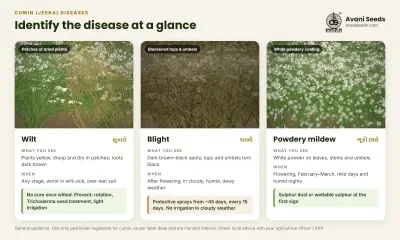
Cumin (jeera) has three main diseases:
| Disease | What you see | When it comes | What works |
|---|---|---|---|
| Wilt (સુકારો) | Plants dry out in patches | Any stage | Prevention only: clean seed, seed treatment, crop rotation and light irrigation |
| Blight (ચરમી) | Dark brown to black spots, then the plant tops blacken | After flowering, in cloudy, humid weather | Protective sprays from about 45 days after sowing |
| Powdery mildew (ભૂકી છારો) | White powder on the leaves | Flowering stage, February–March | Sulphur dust or spray at the first sign |
Blight is the most dangerous of the three. It can destroy a field within a week, so the most important rule is to start protection before you see the disease, not after.
Cumin is a high-value crop, but it is also one of the most disease-prone crops a farmer can grow. In research trials in Gujarat and Rajasthan, untreated cumin plots often gave less than half the yield of protected plots. This guide shows how to tell the three diseases apart, when each one strikes, and a practical plan to protect your crop this rabi season.
Quick Identification: Which Disease Is It?
| What you see in the field | Most likely disease | Crop stage |
|---|---|---|
| Plants turn yellow, droop from the tip and dry up, in patches. Roots look dark brown or black | Wilt (સુકારો / sukaro) | Seedling to flowering |
| Small dark brown to black spots on leaves and stems. Tips and umbels turn black and dry. Looks "burnt" | Blight (ચરમી / charmi) | Flowering to seed filling |
| White, powdery coating on leaves, stems and umbels. Rubs off with your finger | Powdery mildew (ભૂકી છારો / bhuki chharo) | Flowering onward (Feb–Mar) |
Tip: to check for wilt, pull out a drying plant and split the lower stem lengthwise. Brown streaks inside the stem point to Fusarium wilt.
1. Cumin Blight (Charmi): The Fastest Crop Killer
How to Identify Blight
- Small, dark brown to black spots on the leaves, often with a yellow edge
- The spots grow and join together. Leaves, stems and umbels turn black and dry
- From a distance, the field looks scorched or burnt
- Infected umbels give shrivelled, light, dull-coloured seed, which fetches a lower price and can be rejected by exporters
Why and When It Comes
Blight is caused by the fungus Alternaria burnsii. It appears mostly from flowering onward (roughly 50–60 days after sowing). It spreads fast when:
- the sky is cloudy for 2–3 days
- there is dew, fog or light rain
- morning humidity is high (above about 60%)
- the crop is sown late or too densely
- the field is irrigated during cloudy weather
The fungus also survives on seed and on crop debris left in the field. Untreated farm-saved seed can carry it into the next season.
How to Control Blight
Prevention (before the disease appears):
- Sow disease-free, treated seed of a blight-tolerant variety (see "Choose the Right Variety" below).
- Sow on time: in Gujarat, generally November. Use the recommended seed rate. Don't sow too thick.
- Give light irrigations. Don't irrigate when the sky is cloudy after flowering.
- Avoid extra nitrogen. Lush, soft growth gets blight sooner.
- Remove and burn crop debris after harvest, and don't grow cumin in the same field every year.
Protective sprays (from about 45 days after sowing):
Research at ICAR-National Research Centre on Seed Spices, Ajmer found that 3–4 sprays at 15-day intervals, starting 45 days after sowing, gave the best blight control. The best sequence in that trial was:
| Spray | Days after sowing | Fungicide (active ingredient) | Dose tested per litre of water |
|---|---|---|---|
| 1st | 45 | Mancozeb 75% WP | 2 g |
| 2nd | 60 | Difenoconazole 25% EC | 0.5 ml |
| 3rd | 75 | Azoxystrobin 23% SC | 1 ml |
| 4th (if weather stays cloudy) | 90 | Repeat a different group from the last spray | as per label |
In the same research, the ready-mix azoxystrobin + difenoconazole (0.5 ml per litre) gave the highest reduction in blight among the newer products tested. Other studies found tebuconazole and propiconazole effective too.
Important: if cloudy weather is forecast, give the next spray before the clouds come. Don't wait for spots to appear. Once blight is visible on most plants, sprays can only slow it down, not undo the damage.
2. Cumin Wilt (Sukaro): The Soil-Borne Problem
How to Identify Wilt
- Plant tips droop and turn yellow. Sometimes only one side of the plant wilts at first
- The whole plant then dries up and dies
- It usually starts in patches, often in the low or wetter parts of the field
- Roots and the base of the stem turn dark brown to black. Inside, the stem shows brown streaks
- Plants infected at flowering give empty or shrivelled seed
Why and When It Comes
Wilt is caused by the soil fungus Fusarium oxysporum f. sp. cumini. It lives in the soil for years. It is worst when:
- cumin is grown in the same field year after year. Fields with continuous cumin for 4–5 years show the highest wilt
- the soil is poorly drained or over-irrigated
- the weather is warm at sowing and in the early growth stage
- seed is untreated
How to Control Wilt
There is no spray that cures a wilted plant. Wilt is controlled by prevention:
- Crop rotation: don't grow cumin in a wilt-affected ("wilt-sick") field for at least 3 years. Rotate with crops like wheat, mustard or isabgol.
- Summer deep ploughing: plough deep in May–June. This exposes the soil to the hot sun and reduces the fungus.
- Seed treatment with Trichoderma: ICAR-NRCSS research found that seed treatment with Trichoderma viride at 10 g per kg of seed plus soil application at 2.5 kg per hectare (mixed with well-rotted FYM) gave the lowest wilt. A fungicide seed dressing approved for cumin can also be used (check the label).
- Add organic matter: well-rotted FYM or neem cake improves the soil and supports beneficial microbes.
- Irrigate lightly: heavy irrigation and waterlogging spread wilt. Level the field so water doesn't stand in low spots.
- Pull out wilted plants with their roots and destroy them outside the field. Don't leave them lying in the field.
- Balanced fertiliser: give enough potash, and avoid too much nitrogen.
3. Powdery Mildew (Bhuki Chharo): The White Powder
How to Identify Powdery Mildew
- White, powdery patches on the leaves, which later spread to stems, flowers and umbels
- The leaves curl, turn pale and fall off
- Seed stays small and light, and oil content drops
Why and When It Comes
Powdery mildew is caused by Erysiphe polygoni. It usually comes at flowering, in February–March, when:
- days are mild (about 20–28°C) and nights are humid
- the crop is dense and gets little sunlight inside the canopy
- too much nitrogen has been applied
How to Control Powdery Mildew
- Sulphur dusting: at the first sign of white powder, dust sulphur (300 mesh) at 20–25 kg per hectare, early in the morning when the plants are slightly moist with dew.
- Or a sulphur spray: wettable sulphur 80% WP at 2 g per litre (0.2%). Research at the Seed Spices Research Station, SDAU Jagudan found two sprays of wettable sulphur (0.2%) or difenoconazole (0.05%) effective against powdery mildew in cumin.
- Repeat after 15 days if the disease continues.
- Don't use sulphur in hot afternoon sun. It can burn the leaves.
- Maintain proper spacing (about 30 cm between rows), and don't overdo nitrogen.
Season Plan: Cumin Disease Protection Calendar
This is a sample plan based on research schedules. Adjust it to your weather, field history and local agriculture officer's advice. Don't spray just by the calendar if the weather is dry, clear and there is no disease risk.
| Stage | Days after sowing | What to do | Mainly for |
|---|---|---|---|
| Before sowing | – | Summer ploughing, FYM + Trichoderma in soil, crop rotation | Wilt |
| Sowing | 0 | Treated, disease-free seed of a tolerant variety. Don't sow too thick | Wilt, blight |
| Early growth | 25–30 | Light irrigation only. Remove any wilted plants | Wilt |
| Pre-flowering | 45 | 1st protective spray (e.g. mancozeb) | Blight |
| Flowering | 60 | 2nd spray (a triazole, e.g. difenoconazole) | Blight, powdery mildew |
| Flowering to seed set | 70–80 | Sulphur dust or wettable sulphur if white powder is seen | Powdery mildew |
| Seed filling | 75 | 3rd spray (a strobilurin, e.g. azoxystrobin), especially before cloudy weather | Blight |
| Seed filling | 90 | 4th spray only if needed, and only if the pre-harvest interval allows | Blight |
| Harvest | ~100–115 | Stop all sprays well before harvest. Remove and burn crop debris after harvest | Residue, next season |
6 Mistakes That Make Cumin Diseases Worse
- Irrigating when it's cloudy after flowering. This is the most common trigger for blight.
- Sowing too thick. A dense crop stays wet for longer and gets blight and mildew sooner.
- Using the same fungicide again and again. The fungus can become resistant. Rotate fungicide groups (for example mancozeb, then a triazole, then a strobilurin).
- Waiting for symptoms before the first blight spray. By then it's often too late.
- Growing cumin in the same field every year. This builds up wilt in the soil.
- Spraying close to harvest. Residues above the permitted limit can get your cumin rejected by traders and exporters, especially for Europe. Always follow the pre-harvest interval on the label.
Choose the Right Variety: Your First Line of Defence
No cumin variety is fully immune to these diseases. A tolerant variety still gives you a much better start, and gives your sprays more room to work.
| Variety | Duration | Disease reaction | Good for |
|---|---|---|---|
| AVANI-111 | 85–95 days | Tolerant to blight and wilt | Shorter season. Escapes late-season blight and heat |
| AVANI-121 | 105–115 days | Resistant to blight, tolerant to wilt | Higher aroma and oil content. Blight-prone areas |
👉 See full details of both varieties on our cumin seeds page, or read our guide to the best cumin seed varieties for high yield in India.
Frequently Asked Questions
How do I control blight in cumin?
Start protective fungicide sprays about 45 days after sowing, before blight appears, and repeat every 15 days, especially before cloudy weather. Research has found a sequence of mancozeb, then difenoconazole, then azoxystrobin effective. Also avoid irrigation in cloudy weather, sow on time and don't sow too thick.
What is the difference between cumin blight and cumin wilt?
Blight is a leaf and stem disease. It causes dark brown to black spots, and the tops of the plants blacken, mostly after flowering in cloudy, humid weather. Wilt is a soil-borne disease. Whole plants droop, turn yellow and dry up in patches, and the roots turn dark brown.
Can a wilted cumin plant be saved?
No. Once a cumin plant has wilted, no spray can revive it. Pull out and destroy wilted plants, and prevent wilt with crop rotation, summer ploughing, Trichoderma seed and soil treatment, and light irrigation.
When does powdery mildew come in cumin?
Powdery mildew usually appears at flowering, around February–March, when days are mild and nights are humid. Dust sulphur or spray wettable sulphur at the first sign of white powder on the leaves.
Why does cumin get blight after cloudy weather?
The blight fungus needs moisture on the leaves to infect. Cloudy days, dew, fog and high humidity keep the leaves wet for longer, so the fungus spreads very fast. Spray before cloudy weather arrives, and don't irrigate during it.
Which cumin variety is resistant to blight?
No cumin variety is fully immune to blight. Tolerant or resistant varieties reduce the risk. AVANI-121 is resistant to blight and tolerant to wilt, and AVANI-111 is tolerant to both blight and wilt.
Talk to Our Team
Not sure which disease is in your field, or which variety suits your area? Send a photo of the affected plants to our team, or ask your nearest Avani Seeds dealer.
📞 +91 99244 48550 · ✉️ info@avaniseeds.com
Explore AVANI cumin varieties →
This article is general guidance. Always use pesticides registered for cumin, follow the product label for dose and pre-harvest interval, and check local recommendations with your agriculture officer or Krishi Vigyan Kendra.