
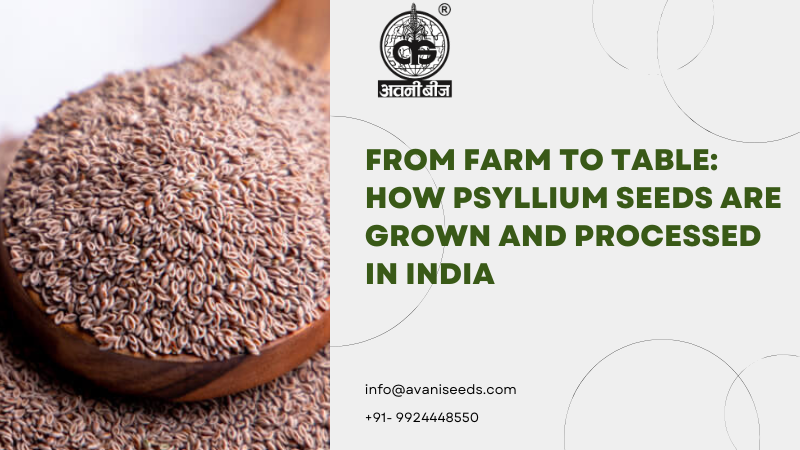
Psyllium seeds, also known as Isabgol, are one of India’s most valuable agricultural products. Famous for their digestive and heart health benefits, these tiny seeds travel a long journey from rural farms to households across the globe. India is the largest producer and exporter of psyllium seeds and husk, making it an essential part of both local wellness traditions and international health markets.
In this blog, we will explore how psyllium seeds are grown, harvested, and processed in India before they reach your table.
Where Are Psyllium Seeds Grown in India?
India dominates global psyllium production, with Rajasthan, Gujarat, and Madhya Pradesh being the leading cultivation states. The sandy soil and dry climate of Rajasthan make it the most suitable region for growing high-quality psyllium seeds.
Farmers usually sow the crop in November or December and harvest it by April or May, taking advantage of India’s semi-arid climate. The seeds require very little water, making psyllium a sustainable and farmer-friendly crop.
Step 1: Cultivation and Farming
The journey begins with careful seed selection. Farmers choose certified seeds to ensure better yield and disease resistance. The crop is sown in rows and requires minimal irrigation.
- Soil Preparation: Loose, sandy soil helps the roots develop well.
- Natural Growth: Since psyllium is hardy, it grows with limited use of pesticides.
- Harvesting Time: Once the crop matures, the plants are cut and left to dry under the Indian sun.
This eco-friendly farming approach has helped India maintain its global leadership in psyllium seed production.
Step 2: Harvesting and Seed Collection
After drying, the psyllium stalks are threshed to separate the seeds. Farmers often use traditional methods combined with modern threshing machines to ensure efficiency.
The seeds are then cleaned to remove dust, husk fragments, and other impurities. This step is crucial because psyllium is mostly consumed as a health supplement, and purity determines quality.
Step 3: Processing Psyllium Seeds in India
Once collected, psyllium seeds are sent to processing units in India, mainly located in Gujarat and Rajasthan.
Here, the seeds go through multiple stages:
- Cleaning and Grading: Machines sort seeds by size, weight, and quality.
- Dehusking: The outer husk is carefully removed. The husk is the most valuable part, as it swells when mixed with water and provides high fiber content.
- Grinding: Depending on demand, husk is processed into fine powder or capsules for dietary use.
- Packaging: Processed psyllium is hygienically packed for both domestic use and export.
This careful chain of processing ensures that psyllium products from India meet international standards.
From India to the World: Exporting Psyllium
India supplies more than 80% of the world’s psyllium husk demand. Major export markets include the United States, Europe, and the Middle East. Indian psyllium products are known for their natural purity, high swelling index, and strict quality control.
Why Psyllium Seeds from India Are Special?
- High Fiber Content: Rich in soluble fiber, psyllium supports digestion and heart health.
- Ayurvedic Roots: Used in Indian Ayurveda for centuries as a natural remedy.
- Global Demand: India’s unique climate and soil give its psyllium unmatched quality.
Whether consumed in a glass of water, mixed in baked goods, or used in dietary supplements, psyllium from India continues to make its mark worldwide.
Conclusion
The story of psyllium seeds in India is truly a farm-to-table journey. From the sandy soils of Rajasthan to advanced processing units in Gujarat, every step reflects India’s agricultural expertise and commitment to quality.
So, the next time you use psyllium husk for digestion or wellness, remember that it started its journey on Indian farms, nurtured by farmers, and processed with care to reach your home.
